

By Richard Croxford, Senior Copywriter, UK.
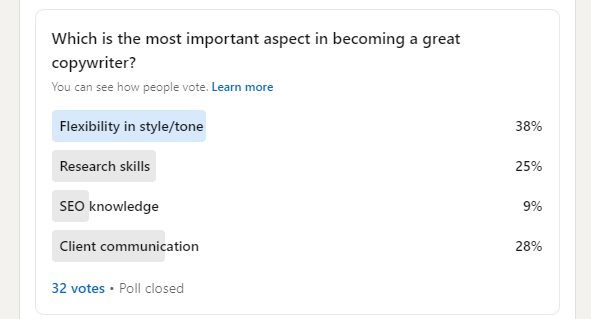
In a recent LinkedIn poll, I asked: “Which is the most important aspect in becoming a great copywriter?”
The options I gave were:
- Flexibility in style/tone
- Research skills
- SEO knowledge
- Client communication
Many of my fellow marketing professionals answered and I think the results reveal some interesting insights.
So, I thought I’d break down the key elements that make a great copywriter and offer my advice on how to hone those skills.
Flexibility in style and tone

38 per cent of you said this was the most important aspect in becoming a great copywriter and I wholeheartedly agree.
I think it’s important to realise that copywriters don’t just write – they write for someone.
That means understanding the audience, the brand’s voice, and the message you’re trying to convey.
My experience:
I once had to write for a medical negligence solicitor, and the challenge was finding the right balance between professionalism and empathy.
In the same week, I had a project for an upbeat SaaS brand.
The writing couldn’t have been more different, but the key to success was my flexibility.
My advice:
If you’re struggling to switch styles, try studying the brand or product’s existing tone of voice.
What words do they use frequently?
What emotions are they trying to evoke?
The more you immerse yourself, the easier it becomes to shift gears.
Also, practice writing in different styles and formats – it’s like working a muscle – and reading a wide variety of authors and texts.
Client communication

28 per cent of you said that good communication with clients and teams was the most important skill to master when it comes to copywriting.
In my DMs, many of you highlighted the importance of understanding the brief, asking the right questions, and delivering on expectations.
I’d agree.
I’ve found that the best copywriters aren’t the ones who can write the longest paragraphs or the cleverest puns – they’re the ones who can listen, clarify, and collaborate effectively.
My experience:
There was a time when I was juggling multiple projects, and my client communication slipped.
One client was unhappy with a piece of content that missed the mark, and it boiled down to miscommunication.
After that experience, I’ve been trying to implement clear feedback loops from people I know will give me constructive criticism when I need it.
I’ve also been going against my Gen-Z mindset and increasing the frequency and depth of my communications – even picking up the phone occasionally.
My advice:
Make sure you schedule regular check-ins with clients.
Even a quick email summarising what you’re working on can keep things on track and build trust.
Good communication also means managing expectations – if a project’s timeline looks unrealistic, speak up early.
Research skills

25 per cent of you said this was the most important aspect of copywriting and, whilst a much smaller number, I would agree that research is often the backbone of any solid piece of copy – especially in my job.
I often find myself writing about complex tax regulations one minute and the latest trends in social media the next so having a well-rounded knowledge is essential.
My experience:
When I’m working on a blog about, say, probate laws for cohabiting couples, I spend a significant amount of time fact-checking, reading the literature, and getting familiar with the legal landscape.
When I first started, I underestimated the importance of research.
I thought I could ‘wing it’ and figure out the details later but I quickly learned that without solid research, the writing feels hollow.
A blog I worked on for a solicitor’s website was all over the place because I didn’t understand the nuances of the law.
It was a hard lesson, but one I’ve carried with me ever since.
My advice:
Make research a habit.
Dive deep into reliable sources, and make sure you’ve got a clear understanding before you start writing.
For efficiency, bookmark trustworthy industry-specific resources you can return to for quick reference.
SEO knowledge

Unsurprisingly, SEO knowledge ranked low in the poll – around 9 per cent of you said it was the most important aspect in being a good copywriter.
Let us not forget that while SEO is one of those additional considerations that often goes unnoticed, it plays a huge role in getting your copy seen.
Even if you’re writing the most engaging copy, it’s useless if no one can find it online.
Understanding how to weave keywords naturally, using metadata effectively, and staying updated on SEO trends are all part of the job.
Having said that, whenever anyone asks me about SEO I always say:
“Write first, SEO later.”
A good piece of copy is the first step in getting your SEO off to a good start.
My experience:
I once worked on a blog post that was beautifully written, but it didn’t rank anywhere on Google because I hadn’t optimised it for SEO.
After revisiting the piece with a focus on SEO – restructuring it, adding headings, and incorporating keywords – it slowly started to climb the rankings.
As an SEO lead in the agency, it’s often difficult to find a balance between writing and writing for SEO.
My advice:
Even if SEO isn’t your strong suit, make sure you understand the basics.
It’s not just about stuffing keywords into a blog; it’s about user intent, structure, and readability.
I recommend using tools like Yoast (if you’re on WordPress) to guide you, or even taking a short free course on SEO.
That said, I maintain that SEO isn’t the be all and end all – learn to write well before you venture into it.
My final thoughts
While these are just a few of the most important skills, becoming a great copywriter requires continuous learning and adaptation.
You need to juggle multiple responsibilities – from strategist to communicator to researcher – all while producing compelling, on-brand content.
So, the next time someone says copywriting is just about writing, you can confidently say: it’s a whole lot more than that.
If you’re looking to improve, focus on building these skills, and remember, copywriting is about communication – not just with the reader but with your clients, your team, and even yourself.
For copywriting advice, please follow me on LinkedIn, or subscribe to Absurd Insights!



 Absurd Insights
Leave a comment