

One of the most important elements to learn when you start your journey to becoming an SEO strategist is meta descriptions.
They are one step up from on-page SEO techniques like headings, readability and external links but they are fairly easy to manage if you put a bit of thought into them.
Generally, I would recommend that meta descriptions are left to the copywriting team. They will likely have the best chance of coming up with something punchy and eye-catching.
Having said that, AI and ChatGPT does an alright job of meta descriptions too so that’s always an option.
Here are some of the tips, tricks, and lessons I’ve learned about writing meta descriptions.
What are meta descriptions and why are they important?
Meta descriptions are the brief snippets that appear beneath a webpage’s title in search engine results.
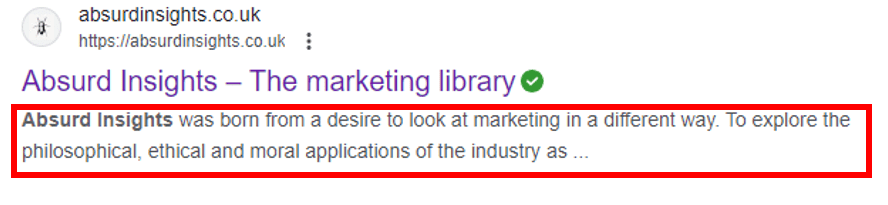
Their role is crucial for both search engines and users.
Search engines rely on meta descriptions to understand the content of a page, helping them deliver relevant results to users.
Whereas users can quickly read a brief description of the page and find out whether they should click or not.
As such, they need to be enticing as well as descriptive – as with everything SEO, it’s a balancing act between readability, user experience (UX) and search optimisation.
The character limit challenge
Meta descriptions require brevity because they are limited to 50-160 characters.
This limitation challenges copywriters to convey the essence of the content succinctly as well as create an eye-catching sentence or two.
Fundamentally, the goal is to capture attention and entice users to click through to the full content.

Optimising meta descriptions: A practical guide
This is the part where I give you some tips and tricks for writing meta descriptions that work well for SEO and UX.
- Use keywords: Incorporate relevant keywords naturally into your meta descriptions. However, avoid keyword stuffing—maintain a balance that ensures clarity and readability.
- Think about your Unique Selling Proposition (USP): Highlight what sets your content apart. Whether it’s unique insights, engaging storytelling, or practical solutions, let your meta description communicate the value users can expect.
- Include a call to action: Encourage user engagement with a clear call to action in your meta description. Invite users to learn more, discover, or take action. A compelling call to action increases the likelihood of clicks.
- Use ‘Snippet Preview’ and ‘Rich Snippets’: Before publishing, use snippet preview tools to see how your meta description will appear in search results. Additionally, consider incorporating schema markup to enhance your snippet with additional information like star ratings, prices, and more.

The Absurd Insight on meta descriptions
How important are they and should you prioritise them?
I think we need to see meta descriptions as not just signals to search engines but also invitations to users.
They are a preview of your content for your reader – which is arguably a more important factor than SEO in any case.
A well-crafted snippet can create an instant connection between your content and the audience so, for that alone, meta descriptions are worth putting some thought into.
What about from an SEO perspective?
The first thing you should know is that meta descriptions influence click-through rates directly.
A well-optimised snippet not only improves your SEO standing but also encourages users to click and explore your content which is a fundamental element in the user journey from search results to engagement.
For SEO purposes, meta descriptions are pragmatic tools that could genuinely improve your search engine performance, which is always a good thing.
As copywriters, our role is to communicate clearly and compellingly, and meta descriptions are an extension of that responsibility as well as a firm SEO strategy you can use to great effect.
For more SEO knowledge, click here. Or, for weekly SEO content, please subscribe below!




 Absurd Insights
Leave a comment